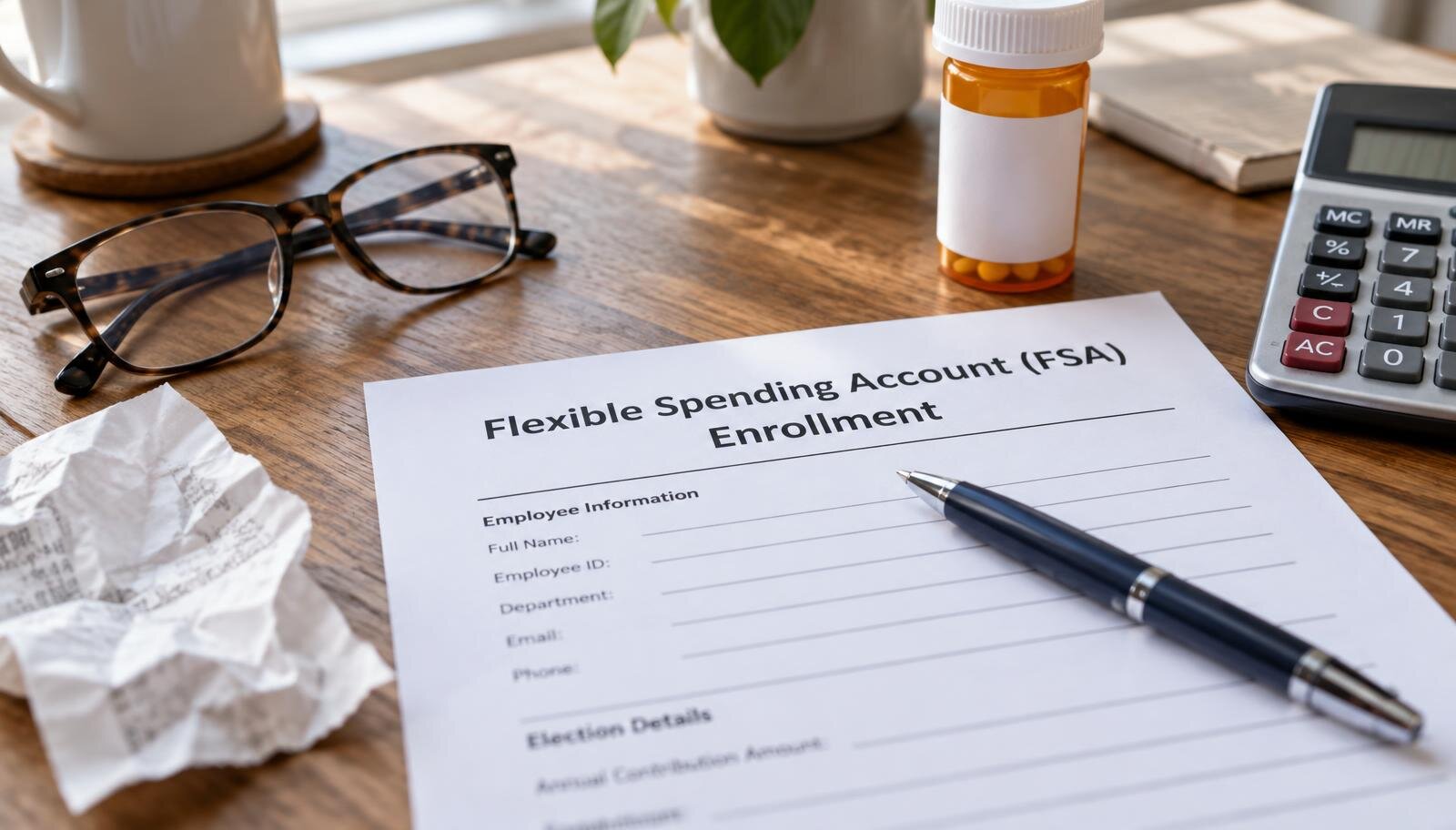
An FSA can take a real bite out of your medical or child care costs, but only if you choose the right amount and remember to spend it.
If your job offers benefits, there's a good chance you've seen the letters FSA on your enrollment forms. A flexible spending account is a workplace benefit that lets you set aside part of your paycheck, before taxes, to pay for certain expenses. Used well, it's one of the simplest ways to make everyday health or child care costs a little cheaper.
The catch is that FSAs come with rules that trip people up every year, especially the famous "use it or lose it" rule. This guide explains how FSAs work, what they cover, how they compare with health savings accounts, and how to choose an amount you'll actually use.
How an FSA works
An FSA is set up by your employer, usually as part of a benefits package. During your company's enrollment period, you decide how much to put in for the coming plan year. That amount is then split evenly across your paychecks and moved into the account before income tax and payroll taxes are taken out.
That's where the savings come from. Because the money skips taxes on the way in, and comes out tax-free when you use it for eligible expenses, every dollar in the account goes further than a dollar from your regular take-home pay. How much you save depends on your tax bracket. As a simple example, if your combined federal, state and payroll taxes add up to about 25%, putting $1,000 through an FSA instead of paying with after-tax money could save you roughly $250.
There's a helpful twist with health FSAs. Under IRS rules, you can typically use your full yearly amount at any point in the plan year, even before you've paid it all in. If you elect $1,200 and need a $900 dental crown in February, you can usually be reimbursed right away, even though only a couple of months of contributions have come out of your pay.
Employers may add money to your FSA, but they don't have to. The IRS sets a yearly maximum for how much you can contribute, and it usually rises with inflation, so check your plan materials or irs.gov for the current limit. Your employer is allowed to set a lower cap.
The two main types: health care and dependent care
Health care FSAs are the most common. They cover out-of-pocket medical costs for you, your spouse and your dependents. That includes deductibles and copays, prescription medicines, dental work, eye exams, glasses and contact lenses, and medical supplies like bandages and blood sugar test kits. Since 2020, over-the-counter medicines and menstrual care products have also counted, no prescription needed. Health insurance premiums are not eligible.
Dependent care FSAs are a separate account for the cost of caring for a child under 13, or a spouse or other dependent who can't care for themselves, so that you (and your spouse, if you're married) can work or look for work. That can include day care, preschool, before- and after-school programs and summer day camp. This account has its own yearly limit, set by law, which is separate from the health FSA limit. Unlike a health FSA, a dependent care FSA usually only pays out what you've already contributed so far.
Some employers also offer a limited-purpose FSA, which covers only dental and vision costs (and certain preventive care). It's designed for people who also have a health savings account, because a regular health FSA would make them ineligible to contribute to an HSA.
The use-it-or-lose-it rule, and the two exceptions
Here's the part to remember: money in an FSA generally has to be spent on eligible expenses during the plan year. Whatever is left over at the end is usually forfeited, and your employer can't simply pay it back to you in cash.
Employers can soften this rule in one of two ways, but not both, and they aren't required to offer either. A grace period gives you up to two and a half extra months after the plan year ends to spend leftover money. A carryover lets you roll a limited amount into the next year. The IRS sets the maximum carryover and adjusts it over time, so check your plan for the current figure.
Many plans also have a run-out period, a window after the plan year ends to submit receipts for expenses you already had during the year. This is different from a grace period. It gives you time to file paperwork, not time to spend.
If you leave your job, your health FSA coverage usually ends on your last day unless you continue it through COBRA. Expenses after that date generally aren't covered. If you know you're changing jobs, it can make sense to schedule eligible appointments or refill prescriptions before you leave.
FSA vs. HSA: what's the difference?
People often mix up FSAs and health savings accounts (HSAs). Both let you pay medical costs with pre-tax money, but they work very differently.
An HSA is only available if you're enrolled in a qualifying high-deductible health plan. The account belongs to you, not your employer, so it stays with you if you change jobs. Unused money rolls over every year with no limit on how long you keep it, and in many cases you can invest it.
An FSA is tied to your employer and doesn't require a specific type of health plan. It's mostly a one-year account, with the use-it-or-lose-it rule and only limited carryover. People who are self-employed generally can't have an FSA at all. You also generally can't contribute to an HSA while you're covered by a regular health FSA, although a limited-purpose FSA works alongside an HSA.
In short, an HSA is built for saving over many years, while an FSA is built for spending within one year on costs you can predict.
How to choose your FSA amount
The smartest way to set your FSA election is to start with what you already know. Look back at the last year or two. Add up your copays, prescriptions, dental cleanings and fillings, glasses or contacts, and the over-the-counter medicines and supplies you buy regularly. Then think about the year ahead. Is anyone getting braces, having a baby, scheduling a procedure or due for new glasses?
Many people find it safest to elect a little less than they expect to spend, especially in their first year with an FSA. If your plan offers a carryover or grace period, you have a small cushion. Without one, guessing too high means losing money.
For a dependent care FSA, the math is often simpler because child care costs tend to be steady. Multiply your weekly or monthly care costs by the number of weeks or months you'll use care, then compare that with the yearly limit. If you also plan to claim the child and dependent care tax credit, keep in mind that the same expenses can't be counted twice, so it may be worth comparing the two with a tax professional or tax software.
Once you choose an amount, you usually can't change it during the year unless you have a qualifying life event, such as getting married, having a baby or a change in your or your spouse's job. Most plans also require you to sign up again every year, so the amount doesn't carry forward on its own.
Tips to get the most out of your FSA
Keep every receipt, and consider snapping a photo of each one as soon as you get it. Plans must confirm that what you bought was eligible, so you may be asked for proof even when you pay with an FSA debit card.
Put a reminder on your calendar about two months before the end of your plan year to check your balance. If money is left over, there are plenty of practical ways to use it: an eye exam and a backup pair of glasses, a dental cleaning, a refill of prescriptions, or a stock-up on first-aid supplies and over-the-counter medicines you already use.
Finally, treat your FSA as part of your overall budget, not a separate pot you forget about. When you plan for medical and child care costs ahead of time, an FSA turns predictable expenses into a steady, tax-free line in your monthly plan.
This article is for education only and is not financial advice. Everyone's situation is different.
Content on The Evergreen Edit is for educational and informational purposes only and is not individualized financial, investment, tax or legal advice. Learn more.
This article is for educational purposes only and isn't personalized financial, tax or legal advice. Consider talking with a qualified professional about your situation.

Kiara Miller — Founder & Editor
Kiara Miller is the founder and editor of The Evergreen Edit. He has been doing independent finance research for two decades and reviews every article before it's published.
More about Kiara →Get smarter about your money.
Join readers who get The Sunday Edit every week.