Joby Aviation (JOBY), the company building electric air taxis, reported third-quarter 2026 results after the stock market closed on Wednesday, Nov. 4, 2026. Revenue came in far above what Wall Street expected, and the company raised its sales outlook for the year. The report lands after a rough year for the stock, which had lost about two-thirds of its value in 2026 heading into earnings.
What did Joby report for the third quarter?
Joby said third-quarter revenue was about $55 million, more than double a year earlier and "primarily from Blade," the helicopter and seaplane passenger business it bought in 2025. Analysts had expected roughly $38 million to $39 million, according to Zacks and FactSet. Joby also raised its full-year 2026 revenue outlook by 15% to $135 million to $140 million.
The company is still losing a lot of money, which is normal for a business that has not started its main service yet. Its net loss narrowed about 47% from a year earlier to roughly $212 million, according to a report by Rallies. Joby ended September with $2.2 billion in cash, cash equivalents and short-term investments, and it expects to use $385 million to $415 million in the second half of 2026 (Joby).
- Q3 2026 revenue: about $55 million (forecast: roughly $38 million to $39 million)
- 2026 revenue outlook: raised to $135 million to $140 million, from $115 million to $125 million
- Q3 net loss: about $212 million, about 47% smaller than a year earlier
- Cash and short-term investments: $2.2 billion as of Sept. 30, 2026
- Aircraft in production: 17
If earnings reports are new to you, our guide on how to read a company earnings report explains what revenue, net loss and guidance mean.
Who is Joby Aviation, and what does it do?
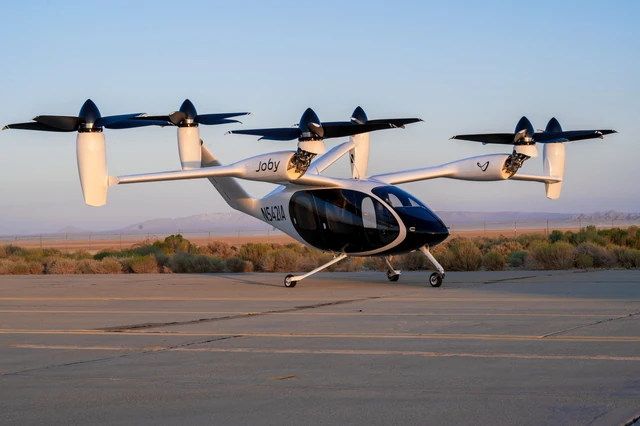
Joby was founded in 2009 by JoeBen Bevirt and is based in Santa Cruz, California. It builds an eVTOL aircraft, short for electric vertical takeoff and landing. Think of it as a quiet, battery-powered cross between a helicopter and a small plane: it lifts off straight up like a helicopter, then tilts its propellers forward to fly like an airplane.
According to Joby, the aircraft carries one pilot and four passengers, flies at up to 200 miles per hour and uses six electric motors with zero operating emissions. The plan is to run it as an air taxi, so riders could book a short hop across a city, such as from downtown to an airport, much like booking a ride-share.
Joby has lined up big partners along the way. Toyota led a $590 million funding round in 2020, and Joby bought Uber's air taxi unit, Elevate, in December 2020, when Uber also invested $75 million. Delta Air Lines signed a multi-city partnership in 2022. Joby became a public company in August 2021 by merging with a special purpose acquisition company, or SPAC, called Reinvent Technology Partners, and its shares trade on the New York Stock Exchange under JOBY.
How close is Joby to flying passengers?
The biggest hurdle is approval from the Federal Aviation Administration. Joby says it is in the fifth and final stage of FAA type certification, the approval an aircraft design needs before it can carry paying passengers, and that it has completed "a wide range of 'for credit' testing with the FAA." It has not given an approval date in its results.
The company also completed its first flights in Texas and Florida under the White House-backed eVTOL Integration Pilot Program, expanded its U.S. Air Force autonomy contracts to about $37 million and announced plans to buy Resonant Sciences, a defense business. Blade, which already flies passengers by helicopter and seaplane, carried more than 44,000 passengers in a record quarter. Joby has also said it is preparing for commercial service in Dubai.
What analysts expect next
Before this report, analysts were mixed. StockAnalysis showed a consensus "Hold" rating from 11 analysts, with price targets ranging from $4 to $18. Their average forecasts called for about $121 million in revenue in 2026, rising to about $215 million in 2027, with losses continuing: an average loss of $0.77 per share in 2026 and $0.65 in 2027. Those estimates were made before Joby raised its outlook, so they may change in the coming days.
- 2025 revenue (reported): about $53 million
- 2026 revenue (company outlook): $135 million to $140 million
- 2027 revenue (average analyst forecast, pre-report): about $215 million
- Expected loss per share (average analyst forecast, pre-report): $0.77 in 2026, $0.65 in 2027
Those are forecasts, not guarantees. Joby's revenue today comes mostly from Blade, not from its own aircraft, and the timing of FAA approval and passenger service will likely drive the numbers far more than any single quarter.
The long-term question: big potential, real risk
Air taxis are the kind of new industry that attracts long-term investors, because a company that becomes a leader in a brand-new market can grow for many years. Joby has a head start in certification, $2.2 billion in cash and major partners, and that is why some investors are willing to wait through years of losses.
But early-stage industries also produce failures, and stocks like this can swing hard in both directions. Joby's shares traded between about $4.43 and $17.51 over the past 52 weeks, and closed at $4.91 on Oct. 27, according to StockAnalysis. Rival Lilium, a German eVTOL maker, ceased operations and laid off about 1,000 workers in December 2024 after running short of money. Nobody can know today which air taxi companies, if any, will turn into lasting businesses.
That uncertainty is why many long-term investors keep any single speculative stock as a small slice of a broader, diversified portfolio. Our guides to asset allocation and diversification and stock market corrections explain how investors think about that risk.
What this means for your wallet
For most savers with a 401(k) or IRA in broad index funds, Joby is a very small piece of their portfolio, if they own it at all. For people buying the stock directly, Wednesday's report shows a company growing revenue and moving through its final certification stage, while still losing hundreds of millions of dollars a quarter. Any investment decision depends on your own goals, timeline and comfort with losing money, and this article is not a recommendation to buy or sell.
Frequently asked questions
What does Joby Aviation do?
Joby builds an electric vertical takeoff and landing (eVTOL) aircraft that it plans to run as an air taxi service. The aircraft carries a pilot and four passengers and flies at up to 200 mph, according to the company.
Is Joby Aviation profitable?
No. Joby lost about $212 million in the third quarter of 2026, according to Rallies, and analysts expect losses to continue through at least 2027. Most of its current revenue comes from Blade, its helicopter and seaplane passenger business.
When will Joby start carrying passengers?
Joby says it is in the fifth and final stage of FAA type certification but has not given an approval date. It has also said it is preparing for commercial service in Dubai.
What is Joby's stock ticker?
Joby trades on the New York Stock Exchange under the ticker JOBY.
Sources
- Joby Aviation, Joby Reports Third Quarter 2026 Financial Results, Nov. 4, 2026
- MarketScreener, Joby Reports Third Quarter 2026 Financial Results, Nov. 4, 2026
- Rallies, Joby Aviation Q3 net loss narrows 47%, Nov. 4, 2026
- Zacks via TradingView, JOBY Gears Up to Report Q3 Earnings
- TipRanks, Joby Aviation Q3 Earnings Preview, Nov. 2, 2026
- StockAnalysis, Joby Aviation stock overview and analyst forecast
- Joby Aviation, Technology
- Wikipedia, Joby Aviation
- Wikipedia, Lilium GmbH
- Photo: Harlan Huntington, U.S. Air Force via Wikimedia Commons (Public domain)
Content on The Evergreen Edit is for educational and informational purposes only and is not individualized financial, investment, tax or legal advice. Learn more.
Compound growth estimate
Estimated total
$17,175
Your contributions
$13,000
This is an estimate, not a prediction. Monthly compounding; taxes, fees and inflation are excluded.
This article is for educational purposes only and isn't personalized financial, tax or legal advice. Consider talking with a qualified professional about your situation.

Kiara Miller — Founder & Editor
Kiara Miller is the founder and editor of The Evergreen Edit. He has been doing independent finance research for two decades and reviews every article before it's published.
More about Kiara →Get smarter about your money.
Join readers who get money stories on their chosen topics, daily or as new articles post.