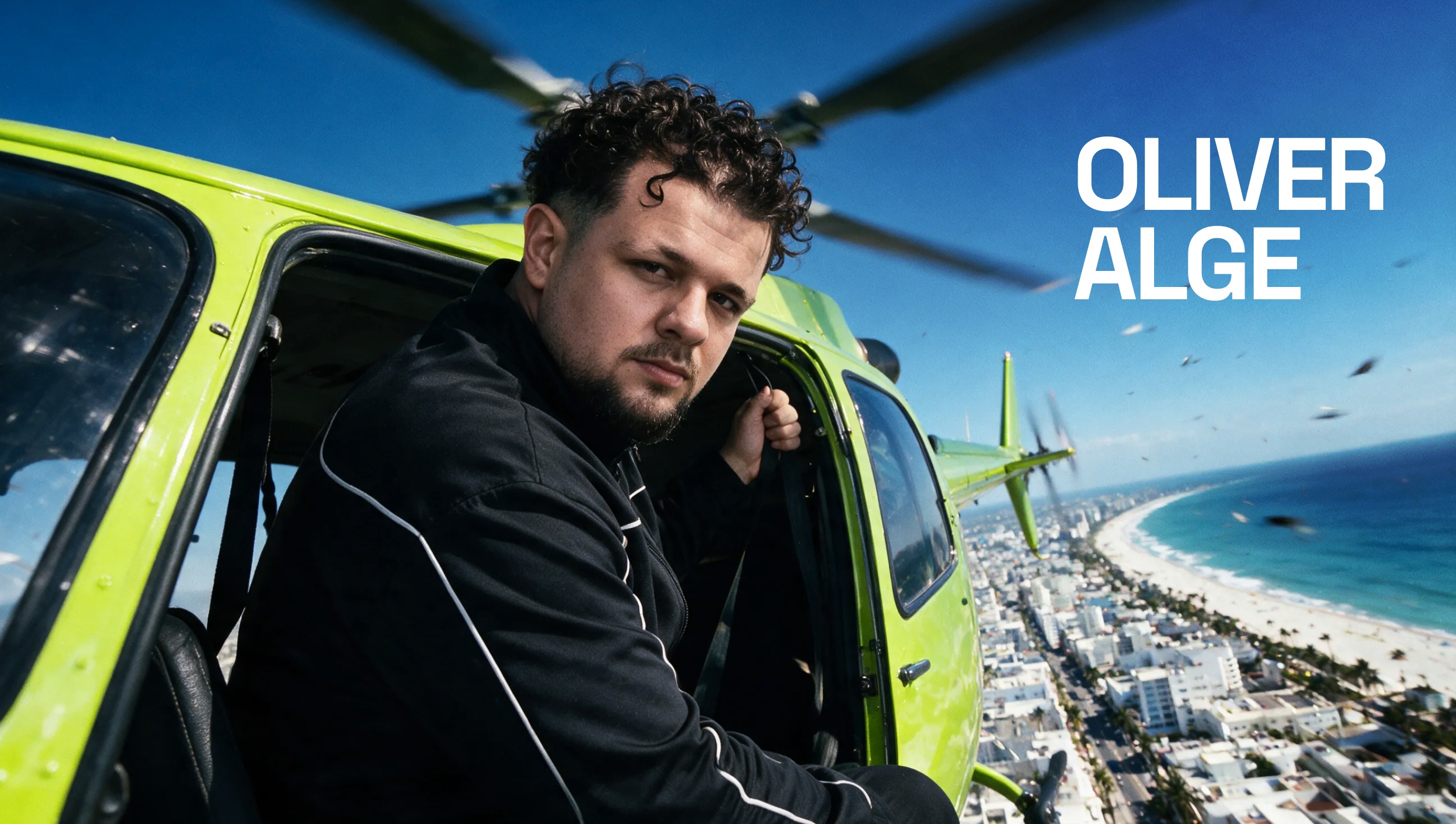
Oliver Alge did not begin with a promise that artificial intelligence would make him rich. He began with a creative skill clients already valued: music production. Then he used Higgsfield to expand into something bigger—music videos, television commercials and demanding brand-production work.
The 24-year-old producer and AI filmmaker is the subject of a Higgsfield case study published October 22, 2026. It describes a fully AI-generated video for established German rap artists, a commercial aired on German national television and two transitions delivered for a Riyadh Air campaign within 24 hours. These are concrete commercial projects, not just a collection of impressive social-media clips. 1
But there is an important financial boundary: the public case study does not disclose Alge's fees, business revenue or profit. We cannot honestly say Higgsfield made him a millionaire—or attach an invented earnings figure to his work. What we can explain is how he used the platform to broaden his services, demonstrate his capabilities and compete for commercially valuable assignments.
Who is Oliver Alge?
According to Higgsfield's interview, Alge works between Germany and the UAE, is signed to BMG Publishing and has gold and platinum music certifications. His catalog has surpassed 500 million streams, and his credits include two German No. 1s. He also works with AO Agency, an AI production studio operating across Germany, Austria and the UAE. 1
Those music achievements matter because this was not a beginner opening a subscription and instantly acquiring a successful business. Alge brought taste, production experience and an established creative track record. The business lesson is to add a new production capability to a skill people already buy, rather than assume the tool will supply your reputation for you.
Streams also are not a measure of his personal wealth. They do not tell us his royalty splits, ownership, expenses or earnings, and the catalog total should not be treated as money generated by Higgsfield.
What he built: three projects with real commercial uses
For the music video “BLN,” featuring Lacazette, Sido and Gangsta Ralph, Alge created the entire video with AI. The concept placed the performers in cinematic worlds, including Sido battling aliens on Mars and Lacazette sailing a large ship through stormy seas. Alge reports that the video reached the top four on YouTube Trending in Germany. Higgsfield explicitly identifies that result as based on his interview, rather than an independently audited performance report. 1
His challenge was not simply making an exciting image. Two performers wore distinctive masks that needed to remain recognizable across shots. Getting those details right is the kind of quality control that separates an entertaining experiment from a deliverable a client can actually release.
For Bonsy, Alge worked from a supplied script about a family struggling to manage its finances. He generated the images and video shots while keeping the family visually consistent. Higgsfield reports that the finished commercial aired on German national television, including ProSieben and RTL. A television screen exposes distorted hands, flicker and continuity mistakes that might be easy to overlook on a phone. Alge described the process as requiring extensive generation and refinement. 1
The Riyadh Air assignment was narrower but time-sensitive: two AI transitions for a Saudi National Day spot, delivered within 24 hours. One connected seat fabric to the traditional craft that inspired it; the other linked the cockpit window's shape to a gazelle's eye. This was a contribution to a campaign—not evidence that he independently created the airline's entire advertisement. 1
How Higgsfield changed his workflow
Alge's process starts with an idea, concept and treatment. He then makes still images of characters and locations, saves them as Elements to preserve consistency, and generates footage using the model appropriate to each shot. Complicated scenes may begin with 3D blocking; video-to-video workflows help refine the result. Cinema Studio brings those steps together instead of making him move repeatedly between separate production websites. 1
The entrepreneurial advantage is not “press a button and get paid.” It is a more connected production process: create references, test shots, compare alternatives and respond to a client's feedback. When the brief changes, a creator can explore another version without necessarily assembling a new physical shoot.
That does not eliminate work. Concept development, editing, sound, quality control, client communication and revisions still require judgment. Alge's experience with the television commercial is a reminder that rejected generations are a production cost, not a footnote.
The €300,000 figure is not his income
One number in the case study could easily become a misleading headline. Alge gives an example of a commercial he estimates would require 14 shooting days and a €300,000 budget through conventional production, compared with around two days using AI. This is his illustrative production comparison—not a disclosed client payment, not a measured profit figure and not evidence that he personally earned €300,000. 1
Lower production effort can create room for a stronger margin, a more competitive quote or more revision options. Which benefit a business actually captures depends on its prices, costs and contract. If every competitor can access similar models, clients may also expect lower prices. Efficiency creates an opportunity; it does not guarantee that the creator keeps all of the savings.
A simple way to evaluate an AI-video business
Consider a hypothetical small studio selling one client project for $2,000. Suppose generation and software allocated to that project cost $250, licensed assets and outside help cost $150, and the owner's 25 hours are valued at $40 per hour, or $1,000. That leaves $600 before overhead and taxes. These are teaching assumptions, not Alge's actual numbers or current Higgsfield prices.
If unplanned revisions add 15 hours at the same $40 hourly value, the additional $600 consumes that entire remainder. The project can look lucrative from its invoice and still deliver little economic profit. Counting your own time is essential, even if you are not yet paying yourself an hourly wage.
A sensible project quote therefore needs a defined deliverable, approval stages, a revision limit and a clear answer to who pays when the scope changes. Keep a record of actual generation spending and time so the next quote reflects your real workflow, not the best-case demo.
What another entrepreneur can learn from him
Start with a customer and a specific problem. A local business needing a product video, an artist needing a coherent visual world and an agency needing two difficult transitions have different briefs. Selling “AI content” is vague; selling a clearly scoped result gives the buyer something to evaluate.
Build a small, honest portfolio. Clearly label speculative work so it cannot be mistaken for a commissioned campaign. Demonstrate consistent characters, intentional lighting and clean edits, rather than dozens of disconnected flashy clips. Never imply that a brand hired you just because you generated an image of its product.
Check commercial-use permissions for the platform and models you use, along with rights to music, logos, people and source material. Get the relevant client approvals. AI does not remove copyright, likeness or advertising responsibilities, and a technically impressive shot is not automatically safe to publish.
Alge also receives support through Higgsfield's Creator Partnership Program, including credits that give him more room to experiment. That relationship is relevant context for a company-published success story. A new customer paying ordinary subscription costs should not assume the same support, and the case study does not establish that the partnership itself directly brought him new clients. 1
The bottom line
Oliver Alge's story shows a creative professional using Higgsfield to expand into commercially significant work: a rap video, a television commercial and a fast-turnaround airline campaign contribution. The impressive result is the breadth and quality of the services he can offer—not an earnings figure nobody has disclosed.
For an entrepreneur, the opportunity is to combine a useful skill with faster iteration and disciplined pricing. Learn the craft, solve a real client's problem, keep your costs visible and judge success by profitable, repeatable work rather than views alone.
Sources
- 1 — Higgsfield: Oliver Alge case study, October 22, 2026. Primary source; project results and production comparisons are attributed to Alge's interview. Higgsfield also supports him through its Creator Partnership Program.
- 2 — RuntimeWire: Coverage of Alge's Higgsfield workflow, October 22, 2026. Secondary coverage based on the same company interview, not independent verification of earnings.
Content on The Evergreen Edit is for educational and informational purposes only and is not individualized financial, investment, tax or legal advice. Learn more.
Which money-saving habit will you focus on next?
This article is for educational purposes only and isn't personalized financial, tax or legal advice. Consider talking with a qualified professional about your situation.

Kiara Miller — Founder & Editor
Kiara Miller is the founder and editor of The Evergreen Edit. He has been doing independent finance research for two decades and reviews every article before it's published.
More about Kiara →Get smarter about your money.
Join readers who get money stories on their chosen topics, daily or as new articles post.