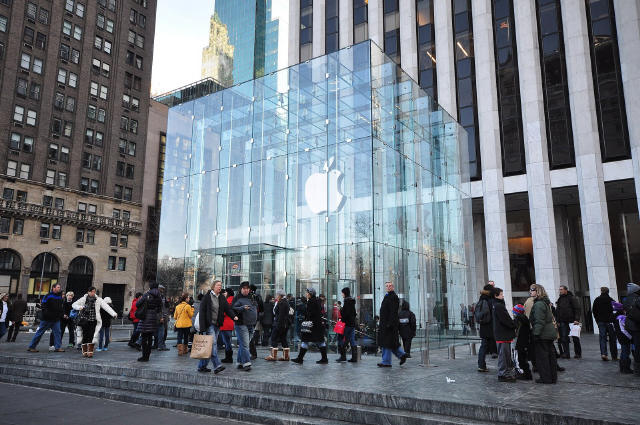

Apple's sales and profit beat forecasts, so the stock's drop came down to one number about the future: how much of each holiday sale it expects to keep.
Why did Apple stock fall after beating earnings?
Apple (AAPL) fell because investors focused on its forecast, not its record quarter. The company expects a holiday-quarter gross margin of 45% to 46%, below the 46.9% analysts expected, as memory chip costs climb. Shares closed down about 1.9% on Tuesday, Nov. 3, after dropping further before the open.
Apple reported its results for the quarter ended Sept. 26 on Monday, Nov. 2, after the market closed. Revenue rose 12% to $114.5 billion and earnings per share (EPS) rose 14% to $2.10. Both were September-quarter records. Investing.com, via Yahoo Finance, said analysts had expected $113.38 billion in revenue and $1.99 a share. Profit was $30.7 billion, up from $27.5 billion a year earlier, MacRumors reported.
The stock moved around a lot. It had already slipped about 1.8% in regular trading Monday, before the report. It then fell as much as 4% in after-hours trading, TradingView reported. Early Tuesday it was down 4.52% at $323.02 in premarket trading, TradingKey reported. By Tuesday's close the loss had narrowed to about 1.9%, or roughly $94 billion of market value, according to StockTitan. That made Apple the main weight on the Dow, even as chip stocks lifted the Nasdaq.
What is gross margin, and why does it matter so much here?
Gross margin is the share of each sales dollar left after the direct costs of making a product or delivering a service. Last quarter Apple kept 47.9 cents of every dollar. That included about one percentage point of help from tariff refunds, which also added $0.05 to EPS, Apple said. Without the refunds, the margin was closer to 46.9%.
Here is a simple way to size the forecast. Apple's December 2025 quarter brought in $143.8 billion in sales and about $69.2 billion in gross profit, or roughly 48.2%. Apple now expects revenue growth of 7% to 10%. Taking the middle, 8.5%, gives about $156 billion. At a 45.5% margin, gross profit would be about $71 billion. At the 46.9% analysts expected, it would be about $73.2 billion.
So the gap between Apple's forecast and Wall Street's hopes is about $2.2 billion of gross profit in one quarter, using our own midpoint math. Gross profit would still rise from a year ago. It just wouldn't rise as fast as many investors had priced in, and a stock near a $5 trillion valuation has little room for that. Our guide to why stocks move after earnings explains how a beat can still lead to a drop.
The cause is memory. Apple's finance chief said pricing for memory chips is "unprecedented," according to MacRumors' live coverage of the call, and Apple expects even higher memory costs this quarter. This is John Ternus' first earnings report as CEO. "It's a privilege to be with you for the first time as Apple CEO," he said.
Where was Apple strong, and where was it weak?
The iPhone was the bright spot. Revenue rose 17% to $57.6 billion, above the $56.6 billion LSEG estimate, TradingView reported. Mac revenue rose 24% to $10.8 billion. iPad revenue fell 10% to $6.2 billion, and wearables, home and accessories fell 8% to $8.3 billion, MacRumors reported.
Two softer spots got attention. Services revenue, a high-margin business, grew 9.8% to $31.6 billion, down from 12.1% growth the quarter before. Apple's 8% to 9% forecast for this quarter trails the 10.7% analysts expected, TradingView reported. Greater China revenue rose about 21% but came in near $17.6 billion, short of Bloomberg's $18.8 billion consensus.
Supply is another open question. Apple's chief operating officer said of the new iPhone Duo that "it is really hard to predict when supply and demand will be in balance," Investing.com reported. Apple also said it expects the December quarter to be its best for revenue ever.
What this means for your wallet
If you own Apple directly, Tuesday's move is simple to measure: a hypothetical $10,000 position that fell 1.9% would be down $190 on paper. The company also declared a $0.27 quarterly dividend, payable Nov. 16 to holders of record on Nov. 12, so 100 shares would receive $27. Our earlier look at Apple's $5 trillion milestone shows how quickly the stock's value has grown this year, which helps explain why expectations were so high.
If you own a broad index fund or a 401(k) target-date fund, you likely hold Apple among hundreds of other companies. Because funds like these weight holdings by size, a giant such as Apple can move them more than a smaller stock does. Our primer on asset allocation and diversification covers how investors think about that concentration.
The wider lesson is about memory prices. Rising chip costs squeeze companies that buy memory, and they can help companies that sell it. On Tuesday, chip stocks rallied while Apple fell, a reminder that one company's cost can be another's revenue.
What should investors watch next?
The next test comes with Apple's December-quarter report, which is likely in late January. Watch whether gross margin lands within the 45% to 46% range, whether iPhone Duo supply catches up with demand, and whether services growth steadies. Any further change in memory pricing could matter too, because Apple said it expects those costs to rise. Comments on tariffs may also matter, since Apple said it has now received the vast majority of its refunds, so that boost may not repeat.
Frequently asked questions
Did Apple beat earnings in its fiscal fourth quarter of 2026?
Yes. Apple reported $114.5 billion in revenue and $2.10 in earnings per share, above the roughly $113.4 billion and $1.99 analysts expected, according to Investing.com.
Why is Apple's gross margin expected to fall?
Apple forecast a December-quarter gross margin of 45% to 46%, down from 47.9%, and said it expects higher memory costs. Last quarter's figure also included about one point of help from tariff refunds.
When is Apple's next dividend?
Apple declared a $0.27 per share dividend, payable Nov. 16, 2026, to shareholders of record at the close on Nov. 12, 2026.
Content on The Evergreen Edit is for educational and informational purposes only and is not individualized financial, investment, tax or legal advice. Learn more.
Compound growth estimate
Estimated total
$17,175
Your contributions
$13,000
This is an estimate, not a prediction. Monthly compounding; taxes, fees and inflation are excluded.
This article is for educational purposes only and isn't personalized financial, tax or legal advice. Consider talking with a qualified professional about your situation.

Kiara Miller — Founder & Editor
Kiara Miller is the founder and editor of The Evergreen Edit. He has been doing independent finance research for two decades and reviews every article before it's published.
More about Kiara →Get smarter about your money.
Join readers who get money stories on their chosen topics, daily or as new articles post.