
The biggest number on a shelf tag tells you what you'll pay at the register. The small one next to it tells you whether it's a good deal.
What is a unit price, and how do you use it?
A unit price is what a product costs per ounce, pound, count or other measure. To use it, find the small price on the shelf tag, make sure two products use the same unit, and compare. The lower number is the cheaper one per unit, whatever the package size.
The University of Minnesota's food program puts it simply: unit pricing is a way to compare similar products to find the best deal. The reason it works is that it removes the package from the math. A jar that looks cheap may hold far less, and a bigger box may cost more per ounce than a small one.
How to read a real shelf tag
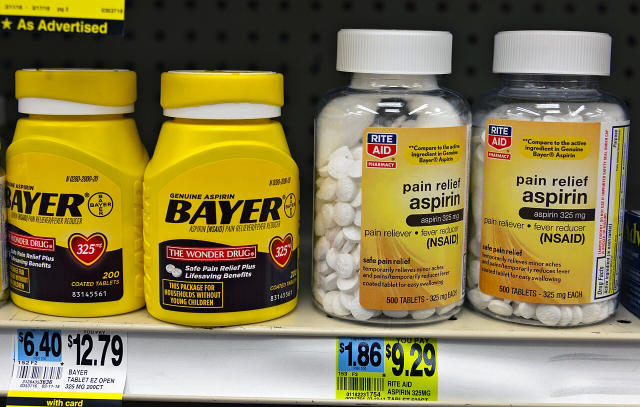
The photo at the top of this article, taken at a U.S. drugstore in 2018, shows how much the small number can matter. Look at the tags under the two aspirin brands.
The Bayer tag shows a price of $12.79 for 200 tablets. Next to it, in smaller print, is $6.40. The Rite Aid tag shows $9.29 for 500 tablets, with $1.86 beside it. Those smaller numbers are the unit prices, and on this shelf the unit is 100 tablets. Both labels say 325 mg of aspirin, and the Rite Aid label invites shoppers to compare it with the Bayer active ingredient.
Here's the math behind the tags. Bayer: $12.79 ÷ 2 (hundreds of tablets) = about $6.40 per 100. Rite Aid: $9.29 ÷ 5 = about $1.86 per 100. The store brand has a lower register price and a much lower unit price, at less than a third of the cost per tablet. That's an old price, so don't read anything into today's numbers. The lesson is what to look at. Without the tag, you'd compare $12.79 with $9.29 and think you were saving about $3.50, when the real gap is about 4.5 cents per tablet across 500 tablets.
Tags differ from store to store, but most show the same pieces of information: the item, the size, the retail price and the unit price. The National Institute of Standards and Technology, the federal agency that publishes the best-practice guide on this, recommends that retailers label it "unit price" and use the word "per." In practice, you may see it in a corner of the tag in tiny print. If you're squinting, you're probably in the right spot.
How do you figure out a unit price yourself?
Sometimes the tag is missing, torn or uses a different unit from the one beside it. The formula is short: item price ÷ item size = unit price. North Dakota State University Extension gives this example: $2.99 ÷ 12 ounces = about 25 cents per ounce.
Your phone's calculator is all you need. Here's a worked example from the University of Minnesota using salad dressing:
- 32-ounce bottle at $3.89: $3.89 ÷ 32 = about 12 cents per ounce.
- 48-ounce bottle at $4.29: $4.29 ÷ 48 = about 9 cents per ounce.
The bigger bottle costs 40 cents more at the register, but you get 50% more dressing. Soup from the same guide shows the same pattern: a 19-ounce can at $2.69 is about 14 cents per ounce, and a 10.5-ounce can at $1.99 is about 19 cents.
If you have a coupon, University of Illinois Extension says to subtract it from the price before you divide. A $4.00 box of 16 ounces is 25 cents per ounce. With a $1.00 coupon, it's $3.00 ÷ 16, or about 19 cents. That can change which product wins, so it's worth running the numbers again once a coupon is in play.
A 4-step check before you put it in the cart
This check takes about 20 seconds once you've done it a few times. You don't need it for everything. It's most useful on items you buy often, or on anything with several sizes on the shelf.
Step 1: Match the unit. One tag may say per ounce and another per pound. Convert before comparing. There are 16 ounces in a pound, so divide a per-pound price by 16 to get per ounce. If one box of pasta shows 18 cents per ounce and another shows $2.59 per pound, the second is about 16 cents per ounce ($2.59 ÷ 16), so it's cheaper, even though the number looks larger.
Step 2: Match the product. A unit price compares only what's in the package. It can't tell you whether two items are truly alike. Check the strength, the ingredients and the quality you want. Store brands are often worth a look here, as the aspirin example shows, but the choice is yours.
Step 3: Look at the whole shelf. North Dakota State suggests comparing forms of the same food, such as fresh, frozen, dried and canned. The University of Minnesota also warns that an end-of-aisle "special" may be the regular price, and that cheaper options can sit on the upper and lower shelves, away from eye level.
Step 4: Ask whether you'll use it all. Illinois Extension notes that a larger package is a good deal only if you can use it before it spoils. We'll work through that next.
Why isn't the lowest unit price always the best deal?
A unit price assumes you'll use every ounce. If you won't, your real cost per ounce is higher, and you can calculate it. Take the package price and divide it by the amount you'll actually use.
Say a 32-ounce tub of yogurt costs $5.50, or about 17 cents per ounce. Small cups cost $1.25 for 5.3 ounces, or about 24 cents per ounce. The tub wins on paper. But if your household usually throws away a quarter of the tub, you're only eating 24 ounces. Now the math is $5.50 ÷ 24, or about 23 cents per ounce. The gap almost disappears, and if you waste a little more than that, the small cups come out ahead. These prices are made up for the example, but the method works with any real numbers.
The same logic applies to cash flow. A warehouse-size pack can have the best unit price and still be the wrong choice in a tight week if it takes money you need for a bill. A low unit price saves money over time, but only if the bigger upfront cost fits your budget. Planning meals around what you buy helps here, and our guide to budget meal planning shows how.
The traps that fool shoppers
Bigger isn't always cheaper. Many people assume the largest size has the best price, and it often does. But NIST has given this counterexample: a 64-ounce bottle of ketchup at $4.49, or 7 cents per ounce, was not as good a deal as a 38-ounce bottle at $2.29, or 6 cents per ounce. Sales can flip the order too, so a small size on sale may beat the big one.
Mixed units on the same shelf. Stores don't always use one unit across a category. You may see per ounce on one tag and per pound or per count on the next. Step 1 fixes that. You also can't compare fluid ounces with weight ounces, because one measures volume and the other weight. Stick to comparing like with like.
Shrinking packages. NIST defines shrinkflation as a cut in a product's net contents without a matching cut in price. The shelf price stays the same, so you may not notice. The unit price is where it shows up. Comparing it to what you remember paying per ounce can reveal a smaller package. Our explainer on shrinkflation has more on how to spot it.
Sale tags without a unit price. A sale sign may hide the regular tag, and it can show only the deal, such as "2 for $5." NIST's guide says retailers should show unit prices on sale signs too, but not all do. Take a second to divide. Two 12-ounce items for $5 is $5 ÷ 24 ounces, or about 21 cents per ounce.
Do stores have to show unit prices?
Not everywhere. NIST says no federal rule requires unit pricing, so it's voluntary unless a state requires it. The agency's guide lists 16 states with laws or regulations in effect: Arkansas, Connecticut, Florida, Hawaii, Maryland, Massachusetts, Mississippi, Montana, Nevada, New Hampshire, New Jersey, New York, Oregon, Rhode Island, Vermont and West Virginia, along with the District of Columbia, Puerto Rico and the Virgin Islands. Those rules vary, and they can change, so your state's weights and measures office is the place to check what applies to you.
Many stores show unit prices even where no law requires it. The same NIST guide cites a Food Marketing Institute figure that 74% of shoppers use unit pricing when it's available. If your store doesn't show it, the formula still works, and it's another reason to keep your phone handy.
What can this add up to?
Small differences on everyday items can add up. As an illustration, if switching sizes or brands saves 40 cents on each of 10 items in a weekly shop, that's $4 a week, or $208 over a year. Your numbers will vary, and some items will have no savings at all. NIST's guide also notes that shoppers often spend what they save elsewhere, so if the goal is to actually keep the money, it helps to decide ahead of time where it goes.
A simple way to start is to pick the five things you buy most, such as coffee, cereal, paper towels, cooking oil and pasta, and check the unit price on each the next time you shop. Once you know a good price per ounce for those items, you can spot a true sale at a glance. For the rest of your list, our guide to cutting grocery costs has more ideas.
Frequently asked questions
How do you calculate unit price?
Divide the item's price by its size. For example, $2.99 for 12 ounces is about 25 cents per ounce.
Is a bigger package always cheaper per ounce?
No. Larger sizes are often cheaper per ounce, but not always, and sales can change the order. Compare the unit prices each time.
Are stores required to show unit prices?
There's no federal requirement. NIST lists 16 states, plus the District of Columbia, Puerto Rico and the Virgin Islands, with laws or regulations in effect, and those rules vary.
How do I compare a per-pound price with a per-ounce price?
Divide the per-pound price by 16 to get the price per ounce, then compare.
Sources
- National Institute of Standards and Technology, Unit Pricing Guide, NIST SP 1181-2025, June 2025
- National Institute of Standards and Technology, February 3, 2015, updated February 3, 2025
- University of Illinois Extension, undated
- University of Minnesota, Real Life Good Food, 2026
- North Dakota State University Extension, FN1752, reviewed July 2024
Content on The Evergreen Edit is for educational and informational purposes only and is not individualized financial, investment, tax or legal advice. Learn more.
Which money-saving habit will you focus on next?
This article is for educational purposes only and isn't personalized financial, tax or legal advice. Consider talking with a qualified professional about your situation.

Kiara Miller — Founder & Editor
Kiara Miller is the founder and editor of The Evergreen Edit. He has been doing independent finance research for two decades and reviews every article before it's published.
More about Kiara →Get smarter about your money.
Join readers who get money stories on their chosen topics, daily or as new articles post.