Before you plug in a space heater or keep an old fridge running in the garage, a two-minute calculation tells you what it really adds to your electric bill.
How do you calculate what an appliance costs to run?
Multiply the appliance's wattage by the hours you use it each day, then divide by 1,000 to get kilowatt-hours (kWh) per day. Multiply that by the number of days and by your electricity rate per kWh. The answer is the energy cost, in dollars, for that period.
In short: watts × hours ÷ 1,000 × days × price per kWh = cost. That one line works for almost anything with a plug, from a phone charger to a dehumidifier. This guide is for renters and homeowners who want to know, before the bill arrives, whether a particular appliance is a few cents a month or a real line item. It walks through where to find each number, then runs the math on several common examples.
The two units you need: watts and kilowatt-hours
Electricity has two measures that are easy to mix up. A watt measures power, or how fast a device uses energy at a given moment. A kilowatt-hour measures energy, or how much was used over time, and it's what your utility bills you for.
The U.S. Energy Information Administration (EIA) explains it simply on its measuring electricity page: one kilowatt is equal to 1,000 watts, and one kWh is one kilowatt used for one hour. The EIA gives a worked example: if you use a 40-watt light bulb for five hours, you have used 200 watt-hours, or 0.2 kWh, of electrical energy.
So a 1,000-watt appliance running for one hour uses 1 kWh. A 100-watt device would need 10 hours to use the same amount. Time matters just as much as wattage. A powerful hair dryer used for five minutes can cost less than a modest device left on all day.
Step 1: Find the wattage
Most appliances list their power on a label or nameplate, usually on the back, bottom or inside the door, or in the owner's manual. Look for a number followed by "W."
If the label shows volts (V) and amps (A) instead, multiply them: watts = volts × amps. A label that says 120 V and 10 A works out to 120 × 10 = 1,200 watts. Keep in mind that this is usually the maximum the device can draw, not what it uses all the time.
That difference matters for anything with a thermostat or a motor that turns on and off. A refrigerator's compressor, a space heater on a thermostat and an air conditioner all cycle. They run at full power for a while, then rest. If you multiply their top wattage by 24 hours, you'll overestimate the cost, sometimes by a lot.
The most accurate way to measure a cycling appliance is an inexpensive plug-in electricity usage meter. You plug the meter into the wall, plug the appliance into the meter, and after a day or a week it shows the actual kWh used. That number skips the guesswork about how often the device runs.
Step 2: Find your price per kWh
Your electric bill is the best source. Many bills list the energy charge per kWh. If yours doesn't, a rough method is to divide the total of the usage-based charges by the kWh used that month.
Be careful with the total bill, though. Many bills include a fixed monthly customer charge that you pay no matter how much you use. That charge won't change if you add or remove an appliance, so it shouldn't be part of the per-kWh rate you use for these calculations. Some utilities also charge more per kWh as your usage rises, or charge different prices at different times of day. If yours does, use the rate that applies when the appliance is running.
For comparison, the EIA publishes the national average residential price each month in its Electric Power Monthly, measured in cents per kWh. The EIA notes that it doesn't collect retail rates directly; its figures are average revenue per kWh sold. Prices vary widely by state and utility, so your own bill is always the better number. The examples below use 18 cents per kWh, which is close to recent national residential averages, simply to keep the math easy to follow.
Worked examples
Each example follows the same formula. The appliances and usage patterns are illustrations, so swap in your own numbers.
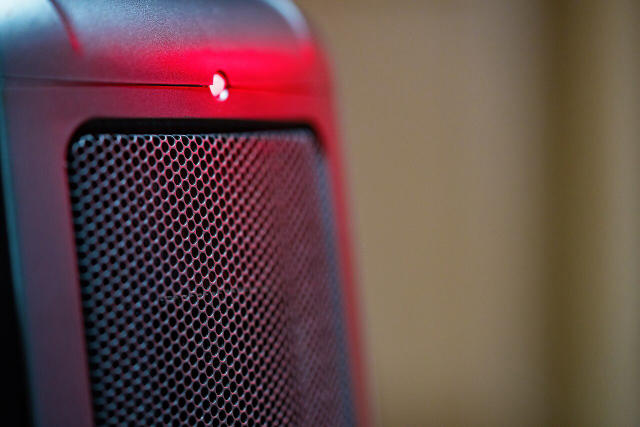
Example 1: A space heater. Say a plug-in space heater is rated at 1,500 watts on its high setting, like the one in the photo above, and it runs 6 hours a day for 30 days. Daily use is 1,500 × 6 ÷ 1,000 = 9 kWh. Over 30 days, that's 9 × 30 = 270 kWh. At 18 cents, the cost is 270 × $0.18 = $48.60 for the month.
Example 2: The same heater on a thermostat. If the heater's thermostat keeps it running at full power only about half the time, the real use is closer to 270 × 0.5 = 135 kWh. At 18 cents, that's $24.30 for the month. This is why a usage meter is worth it for anything that cycles.
Example 3: The same heater at different prices. Run Example 1's 270 kWh at 12 cents per kWh and the cost is $32.40. At 30 cents, it's $81.00. The appliance and the hours didn't change, only the price. That's why the same habit can be cheap in one state and expensive in another.
Example 4: A window air conditioner. Say a window unit draws 800 watts while it's running and runs 8 hours a day for 30 days. That's 800 × 8 ÷ 1,000 = 6.4 kWh a day, or 6.4 × 30 = 192 kWh for the month. At 18 cents, it costs 192 × $0.18 = $34.56. If its compressor cycles off part of that time, the real cost will be lower.
Example 5: Comparing two refrigerators. A refrigerator's EnergyGuide label gives its estimated yearly electricity use in kWh. Say Fridge A is labeled 400 kWh a year and Fridge B is labeled 600 kWh a year. The difference is 200 kWh a year, which costs 200 × $0.18 = $36 a year. If Fridge B is $250 cheaper to buy, Fridge A makes up that gap in about $250 ÷ $36 = 6.9 years at that rate. If you expect to keep the fridge longer than that, or rates rise, the more efficient model looks better.
Example 6: Standby power. Many devices draw a small amount of power while "off," such as TVs, game consoles and chargers. A device drawing 5 watts around the clock uses 5 × 24 × 365 ÷ 1,000 = 43.8 kWh a year. At 18 cents, that's about $7.88 a year. Ten such devices would cost about $78.84 a year. Small on its own, it adds up across a house.
Example 7: How big is it compared with the whole bill? The EIA says in its household electricity FAQ that the average U.S. residential customer bought 10,791 kWh of electricity in 2022, or about 899 kWh a month. Example 1's heater, at 270 kWh, would add about 270 ÷ 899 = 30% to a typical month's use. That puts its cost in perspective.
Reading the EnergyGuide label
When you shop for a new appliance, you often don't need to do the math yourself. The Federal Trade Commission's Energy Labeling Rule, found at 16 CFR Part 305, requires EnergyGuide labels on many products. These include refrigerators and freezers, dishwashers, water heaters, room air conditioners, clothes washers, ceiling fans, televisions, pool heaters and portable air conditioners.
The rule defines two numbers you'll see on those labels. One is the estimated annual energy cost, which the rule describes as the aggregate retail cost of the energy likely to be used in a year. The other is the kilowatt-hour use per year, the estimated annual consumption in kWh. Labels also show a range of estimated annual cost for comparable models, so you can see where one model falls against similar ones.
The yearly cost on the label is based on a national average electricity price, not your rate. For refrigerators, Section 305.14 requires the label to say: "Your cost will depend on your utility rates and use," along with a line giving the national average electricity cost, in cents per kWh, used for the estimate. For the most accurate comparison, take the kWh-per-year number and multiply it by your own rate, as in Example 5. If your electricity costs more than the national average, the savings from an efficient model will be larger than the label suggests, and smaller if it costs less.
A step-by-step checklist
You can work out any appliance's cost in a few minutes with these steps. Write the numbers down so you can compare options later.
- Find the wattage on the nameplate, or multiply volts by amps.
- Estimate the hours it runs per day, and how many days a month.
- Multiply watts by hours and divide by 1,000 to get daily kWh.
- Multiply daily kWh by the number of days.
- Multiply by your price per kWh from your bill, leaving out fixed monthly charges.
- For anything that cycles, check the result with a plug-in usage meter.
Common mistakes to avoid
The most common mistake is using the maximum wattage for an appliance that cycles. A refrigerator doesn't draw its nameplate wattage every hour of the day, so the math can make it look several times more expensive than it is.
A second mistake is mixing up watts and kilowatts. Forgetting to divide by 1,000 makes every answer 1,000 times too big. If a phone charger seems to cost hundreds of dollars a month, that's usually the reason.
A third is dividing your whole bill, including fixed customer charges and taxes, by your kWh. That makes your rate look higher than the price you actually pay for each extra kWh.
A fourth is forgetting about time. Two appliances with the same wattage can have very different costs if one runs all day and the other runs for minutes.
Finally, don't ignore what the appliance replaces. A space heater in one room may cost money to run, but if it lets you lower the thermostat for the whole house, the net effect on your bills could be different. Comparing both sides gives the real answer.
What to do next
Pick the two or three appliances you suspect cost the most, find their wattage, and run them through the formula with your own rate. For anything that cycles, borrow or buy a usage meter and measure a week of real use. If the results surprise you, our room-by-room guide to lowering energy bills has low-cost ways to cut usage. And if you're weighing a protection plan on a new appliance, our guide to whether extended warranties are worth it uses the same kind of break-even math.
Frequently asked questions
How do I convert watts to kWh?
Multiply the watts by the hours of use, then divide by 1,000. For example, a 1,500-watt heater used for 2 hours uses 1,500 × 2 ÷ 1,000 = 3 kWh.
How much does it cost to run a 1,500-watt space heater?
At full power it uses 1.5 kWh an hour, so the hourly cost is 1.5 times your price per kWh. At 18 cents per kWh, that's 27 cents an hour, though a heater on a thermostat usually cycles and costs less.
Is the cost on the EnergyGuide label what I'll actually pay?
Not exactly. The label's yearly cost uses a national average electricity price, so multiply the label's kWh per year by your own rate for a closer estimate.
Sources
- U.S. Energy Information Administration, Electricity explained: Measuring electricity
- U.S. Energy Information Administration, How much electricity does an American home use?
- U.S. Energy Information Administration, Electric Power Monthly: End Use
- Legal Information Institute (Cornell), 16 CFR 305.14: Refrigerator and freezer labeling requirements
- eCFR, 16 CFR Part 305: Energy and Water Use Labeling for Consumer Products (Energy Labeling Rule)
Content on The Evergreen Edit is for educational and informational purposes only and is not individualized financial, investment, tax or legal advice. Learn more.
Which money-saving habit will you focus on next?
This article is for educational purposes only and isn't personalized financial, tax or legal advice. Consider talking with a qualified professional about your situation.

Kiara Miller — Founder & Editor
Kiara Miller is the founder and editor of The Evergreen Edit. He has been doing independent finance research for two decades, is a tax preparer, and reviews every article before it's published.
More about Kiara →Get smarter about your money.
Join readers who get money stories on their chosen topics, daily or as new articles post.